Are You Doing Crunches Every Day? Find Out Why This Won't Help You Burn Belly Fat.
The Frustrating Reality of Ab Workouts
We have all been there: you wake up, hit the mat, and push through hundreds of crunches, hoping to finally see a sculpted midsection. It is incredibly frustrating when those exhausting ab workouts do not translate into a flat stomach. If your main goal is to burn belly fat, you might be surprised to learn that focusing solely on abdominal exercises is actually the least effective way to achieve it. The burning sensation in your muscles does not mean the fat above them is melting away.
Debunking the Spot Reduction Myth
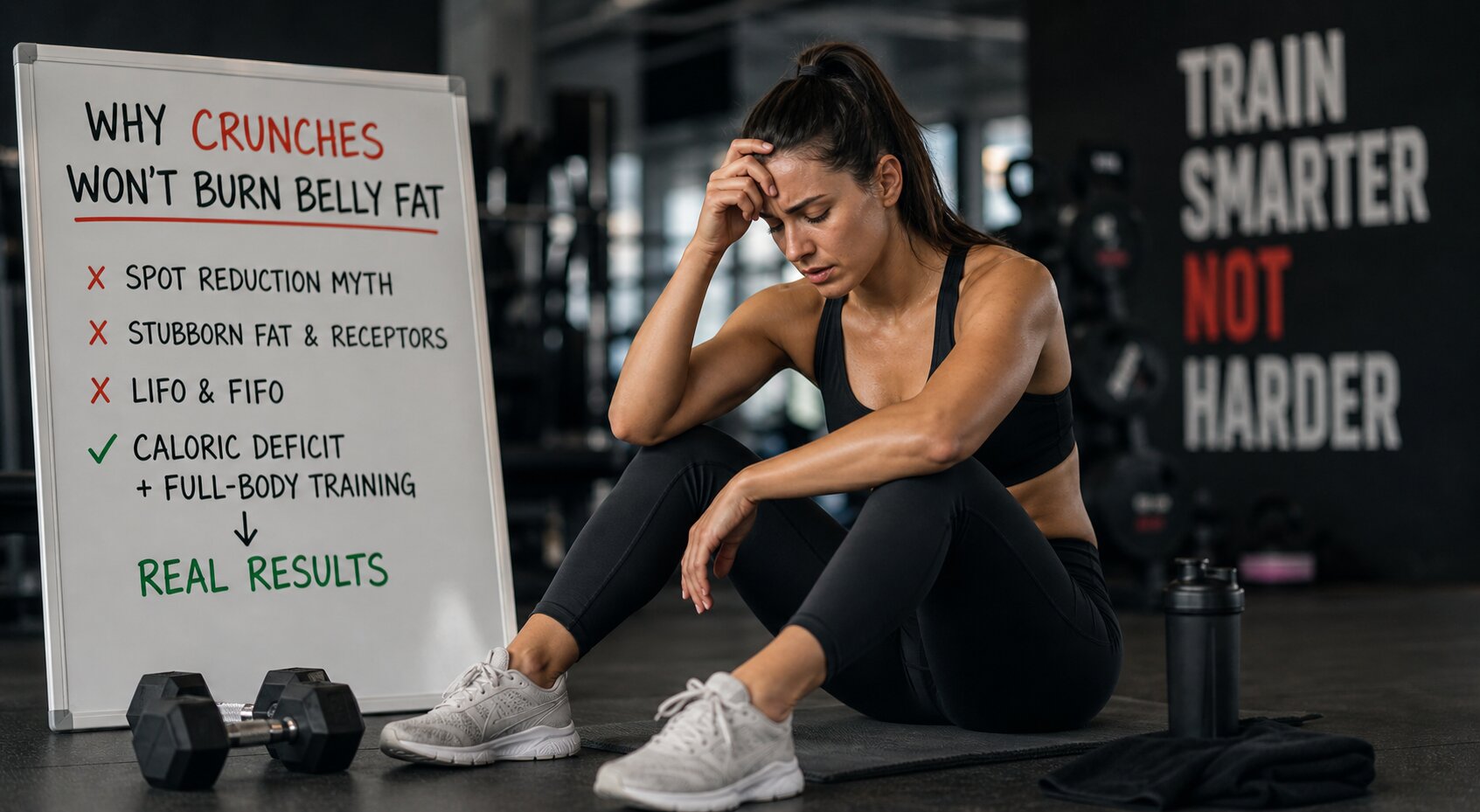
To understand why your crunches are not working, we need to address the spot reduction myth. This is the false belief that you can selectively burn fat in a specific area by exercising the muscle right underneath it. In reality, human physiology does not work that way. A working muscle cannot directly draw energy from the adjacent fat deposits. Instead, fat is mobilized systemically; it is broken down into free fatty acids and glycerol, which enter the bloodstream and are used by the entire body. Large-scale meta-analyses and clinical studies have repeatedly shown that training a specific muscle group does not lead to localized fat loss in that exact anatomical zone.
The Science of Stubborn Fat and Receptors
If fat is burned systemically, why do women struggle to lose fat on their hips, and men on their bellies? The answer lies in your cellular biology—specifically, your adrenoreceptors. Think of beta-receptors as the "gas pedal" for fat burning (lipolysis), and alpha-receptors as the "brakes". Fat cells in the upper body and face typically have a high density of beta-receptors, making them highly responsive to fat-burning hormones. On the other hand, male abdominal fat and female gluteofemoral (hip and thigh) fat are physiologically protected by a high concentration of alpha-receptors. This high density of "brakes" severely restricts blood flow and slows down the release of fat, making these areas incredibly stubborn when you try to diet.
The LIFO and FIFO Concepts
The sequence in which your body stores and burns fat is best explained by the inventory concepts of First In, First Out (FIFO) and Last In, First Out (LIFO). Fat accumulation usually follows a "Bottom-Up" approach (First In): the body secures fat in its preferred, genetically predetermined safe zones first, such as the hips for women and the lower belly for men. However, when you start losing weight, the body operates on a "Top-Down" or LIFO (Last In, First Out) principle. This means the body burns fat from the most accessible, beta-receptor-dense areas first.
This is exactly why your face, shoulders, and chest might slim down rapidly while your belly seems unchanged. It is not a failure of your diet; it is just a normal biological stage. Modern science, however, suggests there might be a slight exception regarding blood flow. Breakthrough studies, such as the 2023 trial by Brobakken et al., suggest that combining heavy systemic aerobic exercise with targeted abdominal endurance training might slightly enhance local blood flow, facilitating better fat mobilization in the trunk area when a caloric deficit is present. But without the systemic energy deficit, the crunches alone do nothing.
The Real Path to a Flat Stomach
Ultimately, to get rid of that stubborn belly fat, you have to outsmart your biology. Since the spot reduction myth has been completely debunked, the only proven path is maintaining a consistent caloric deficit combined with a comprehensive, full-body training regimen. Once your body exhausts the "easy" fat stores, it will be forced to release the energy trapped by those stubborn alpha-receptors. To achieve this without losing muscle mass, you need a proper meal plan for weight loss. Stop wasting your time on endless crunches and start a program that works with your physiology. Visit MyFitTrainingPlan.com today to purchase or download your personalized training and nutrition plan, and let's get you the results you actually deserve.