Home Workouts for Beginners: 3 Simple No-Equipment Routines
On this page
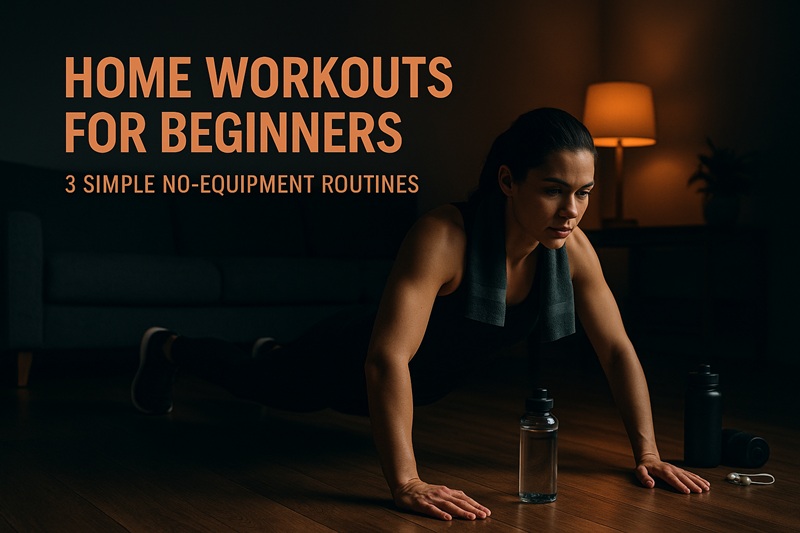
Start with two short, full-body sessions per week. Use controlled versions of a squat, push, hip bridge, and core exercise, stopping while you can still keep good form. The routines below are examples to help you begin; adjust the range of motion, repetitions, and rest to what you can do comfortably.
What a beginner home workout can include
A practical session can cover a knee-dominant movement, an upper-body push, a hip movement, and trunk control. Bodyweight movements can be made easier by changing leverage or support. There is no single routine that suits everyone, and these examples are not an individualized prescription.
Routine 1: Basic full body
- Chair sit-to-stand or comfortable squat: 6–10 repetitions. Use a chair as a depth target or light support.
- Wall push-up: 6–10 repetitions. Stand close to the wall to make it easier; step farther away only when the movement stays controlled.
- Glute bridge: 8–12 repetitions. Lift only as high as you can without arching your lower back.
- Bird-dog: 5–8 slow repetitions per side, or simply slide one foot back if balancing is difficult.
Begin with one round. Rest as needed between movements. If the last repetitions become rushed or your position changes, end the set there.
Routine 2: Standing and floor options
- Supported split squat: 5–8 repetitions per side, holding a stable chair or counter.
- Incline push-up: 6–10 repetitions with hands on a sturdy, non-slipping counter or wall.
- Hip hinge drill: 8–10 repetitions, pushing your hips back while keeping a comfortable, neutral trunk.
- Dead-bug heel tap: 5–8 per side; shorten the movement if you cannot keep your back comfortable.
Use this as a second session later in the week, or repeat Routine 1 if learning the same movements feels more manageable.
Routine 3: A low-impact movement circuit
This optional circuit adds easy movement between strength exercises. March in place at a conversational pace for 30–60 seconds, then do 6–10 chair sit-to-stands and 6–10 wall push-ups. Repeat once if you feel steady and can maintain control. Skip the marching or use a slower pace if it does not feel comfortable.
How to progress without rushing
Repeat a routine until the movements feel familiar. Then change one small thing: add a repetition or two, use a slightly lower chair, or move your hands a little farther from the wall. Keep the change only if you can still move with control. CDC advises adults who are building activity to start slowly and increase duration or intensity gradually; some activity is better than none. CDC: overcoming barriers and starting gradually.
For general adult health, CDC guidance recommends a weekly total of 150 minutes of moderate-intensity aerobic activity and muscle-strengthening activity on at least two days. That is a broad public-health target, not a requirement to complete immediately or a guarantee of a particular result. CDC: adding physical activity as an adult.
Frequently asked questions
Can a beginner get started without equipment?
Yes. Bodyweight exercises and stable household supports such as a wall or sturdy chair can provide simple starting options. Choose a variation that lets you control the movement.
How many days should I do these routines?
Two nonconsecutive days is a straightforward example for practicing strength movements. Adults’ general recommendations include muscle-strengthening activity on at least two days each week, but begin at a level you can manage and build gradually. CDC adult activity guidance.
What if an exercise causes pain or feels unsafe?
Stop that movement and choose a more comfortable option. If you have a chronic health condition or are unsure which activity is appropriate, CDC advises discussing suitable types and amounts of activity with a health professional. CDC guidance.